


History of Hair Transplantation
- Cosmoaid Calcutta

- Jul 23, 2020
- 2 min read
Hair transplantation is widely being used today by many as a remedy for tremendous hair loss and also poses a new hairstyle for an attractive mane. The latest trends and techniques leave one in wonder and make us think about the history of hair transplantation.

In India you can find the best treatment for hair transplant particularly in the metropolitan cities like Kolkata. Check out in online like best hair transplant in Kolkata and stick to it. Before that the history and evolution of hair transplantation unlock interesting facts about the field that has become a craze in the twentieth century. Modern hair transplantation uses a variety of technology like fine FUT, FUE, nanotechnology and robotic surgery. But which was the starting point for all this? Let’s take a look into the fascinating history of hair surgery.
The 19th century:
The history of hair transplantation dates back to the year 1897 when Menahem Hodara did hair transfer. She successfully transferred hair from the unaffected area of the scalp to the area of the head that was affected by flavus.
The birth of modern techniques:
The first documented hair transplant was performed by Dr. Shoji Okuda in 1939. He was a physician from Japan. He used punch hair graft technique for hair transplant and published in Japanese Journal of Dermatology and Urology.
The era of modern hair transplantation bloomed in the late 1950s. The birth of the renowned principle, “Donor dominance” was a revolution for hair transplantation. The theory formulated by Dr. Norman Orentreich was the base for all hair transplantation techniques. He demonstrated that the donor grafts were donor dominant and grew on the recipient's site without any damage.
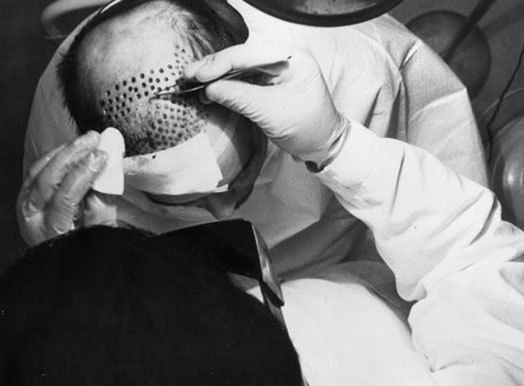
The theory of the Safe donor zone by Walter P. Unger became the fundamental principle for hair transplantation.
The developments of skin grafts occurred in the early 1960s. Skin grafts are hair tissues containing multiple hair follicles from a healthy scalp. The plugs used in these grafts gave a doll’s head-like appearance.
This followed by the development of hand motors and spaced templates which allowed the use of much smaller grafts which are around 2-4 mm. This reduced the artificial appearance that showed while using larger grafts.
The hair plugs were replaced by mini grafts and micro-grafts in the year 1984. This used strips for healthy donor sites instead of larger plugs. This was followed by the use of mega sessions. This uses large numbers of mini-micro grafts. This technique gained much popularity in the 1990s.
In 1994 the history leaped with the formulation of follicular unit transplantation. This technique used individual follicular units from the donor strip that drastically reduced the strip size. It also helped in reducing the trauma on the scalp.
The 21st century saw new pioneering innovations in hair transplantation like follicular unit extraction, robotic FUT, robotic graft selection, and much more.




Comments